Retrieval-augmented generation (RAG) finds passages in your documents and has a language model write an answer from them. A governed knowledge system does that and adds the rules that make answers dependable: every fact has a source, an owner and a date, history is separated from current truth, and access follows your rules. RAG is enough for low-stakes questions over stable material. Production customer answers need the governance layer.
If you are a CTO or head of engineering, you own the failure modes. This guide covers where plain retrieval breaks, what governance adds, and how to decide which one a given use case needs.
What retrieval does, in plain words
You split your documents into chunks. When a question arrives, the system finds the chunks closest in meaning to the question and hands them to a language model. The model writes an answer from those chunks.
The design is sound and quick to build, which is why it is everywhere. It contains an assumption, though: that the closest chunks are the right ones. Closeness in meaning says nothing about which version is current, and everything below follows from that gap.
Where plain retrieval fails
Stale versions
Your library holds the 2023 return policy and the 2025 return policy. Both are close in meaning to a question about returns. Retrieval has no idea which one is current, so it may quote either, or blend them.
Conflicting documents
A sales deck says one thing, a help article says another and a contract template says a third. The model reads all three chunks and writes a confident answer that mixes them. Nobody decided which source wins.
No owner
When an answer is wrong, who fixes it? In a plain retrieval setup the answer comes from a pile of files, and no person is accountable for any one fact. Corrections get made in the chat window and disappear.
No notion of current truth
A document library holds history: old drafts, superseded policies, meeting notes. Retrieval treats all of it as equally valid. A system needs a clear line between what was true and what is true now.
Access leaks
If the index contains internal documents, a clever question can pull a chunk the customer should never see. Filtering after the answer is written is too late. Access has to be enforced at retrieval, using your rules.
No test
A retrieval pipeline can look excellent in a demo and fail on the long tail. Without a suite of real questions with known answers, there is no way to tell whether a change made things better or worse.
What governance adds
Governance is a set of properties and habits layered over retrieval.
- A source, an owner and a date on every fact. The system retrieves from approved facts, and each one has a person behind it.
- History separated from current truth. Superseded material is kept for reference and marked, and the answer layer reads only the current set.
- Conflict flags. When two sources disagree, the system flags the conflict for the owner and does not guess.
- Access rules in the retrieval step. The index respects who is asking.
- An intent classifier. The system decides what kind of question it received, then answers, asks a clarifying question or escalates.
- A test gate and an audit trail. A suite of real questions must pass before launch and after every change, and every answer can be traced to its sources.
For one client, we built a governed system from 7,519 historical customer question-and-answer records. It has an AI intent classifier and three layers of escalation. It passed a 370-question suite with zero errors before launch, and it now answers more than half of the customer questions that used to reach staff.
Comparison
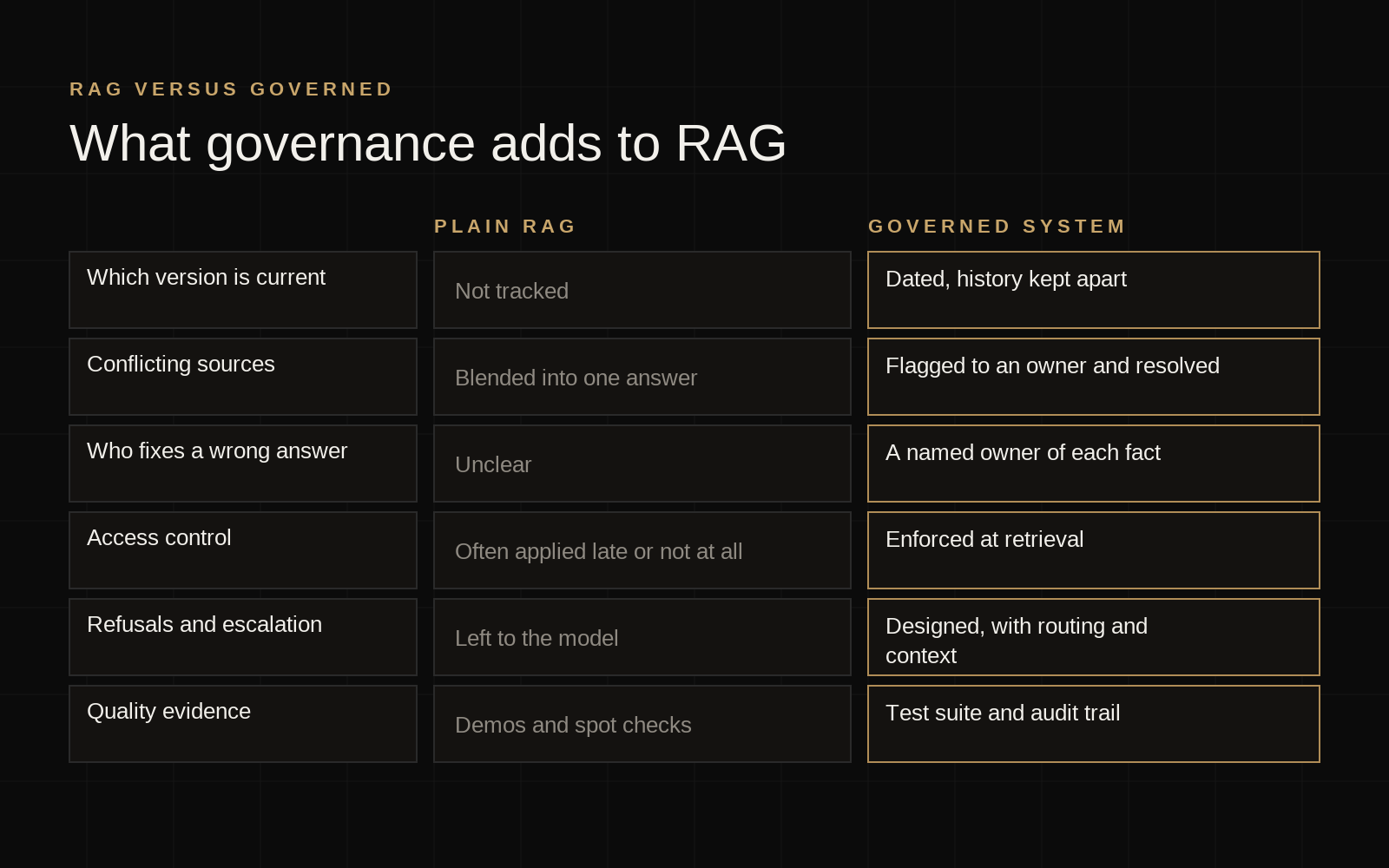
| Concern | Plain RAG | Governed knowledge system |
|---|---|---|
| Which version is current | Not tracked | Dated, with history separated |
| Conflicting sources | Blended in the answer | Flagged to an owner and resolved |
| Who fixes a wrong answer | Unclear | Named owner of each fact |
| Access control | Often applied late or not at all | Enforced at retrieval |
| Refusals and escalation | Left to the model | Designed, with routing and context |
| Quality evidence | Demos and spot checks | Test suite and audit trail |
| Time to first demo | Short | Longer, because sources need owners |
| Fit | Low-stakes, stable material | Customer-facing answers where a wrong answer costs money |
When plain retrieval is enough
Plain retrieval fits when all of these are true:
- The readers are your own staff, who can judge the answer themselves.
- The material changes rarely.
- A wrong answer costs a few minutes and nothing more.
- No access boundaries exist inside the library.
Internal search over a stable engineering wiki is a good example. A customer-facing answer about pricing, eligibility or contract terms is a case for governance.
A practical path: start with retrieval for internal use, learn what your questions look like, and add governance to each intent as it moves toward customers. Our company brain page describes the properties in more detail.
A Monday procedure for engineering leads
- List every place your current retrieval pipeline reads from.
- For ten real questions, trace the answer back to its source files and check the dates.
- Find the pairs of documents that disagree. Count them.
- Check whether any indexed document has an access rule the pipeline ignores.
- Write down who owns each of the ten answers. Mark every blank.
The blanks are your governance backlog.
What goes wrong
- The index is treated as the knowledge base. Anything dropped into the folder becomes an answer. Admission to the index should need an owner.
- Governance is bolted on after launch. Retrofitting owners and dates onto a live system is slower than starting with them.
- Chunking hides context. A chunk with the eligibility rule and a separate chunk with its exception get retrieved apart. Keep rules and exceptions together.
- The model fills gaps. When sources do not cover a question, a model will write something plausible. The system must detect missing coverage and decline.
- Updates lag. A policy changes on Monday and the index refreshes next month. Set the refresh to follow the change.
Questions leaders ask
Is governance a replacement for RAG?
A governed system uses retrieval. Governance decides what goes into retrieval and what the system does with the result.
Does governance slow the build?
The first demo takes longer, because sources need owners and dates. The savings arrive after launch, in fewer wrong answers and faster fixes.
Can we add governance to the pipeline we already built?
Usually yes. Start with the intents that have the highest cost of error, add owners and dates to their sources, separate history from current truth, and put the test suite in front of the release process.
Which model should we use?
Governance works across models. Because the test suite reruns on every change, you can switch or upgrade a model and see the effect the same day.
For the whole picture, read AI Knowledge Systems for Customer Support.
If you want a read on where your own pipeline stands, the Leverage Diagnostic takes about six minutes, scores the six places leverage hides and prices the gap with the math shown.