Company knowledge stays current when every fact has a source, an owner and a date, history is kept apart from current truth, owners review on a set cadence, conflicts are flagged, and a policy change follows a written procedure. A weekly upkeep routine of under an hour keeps an AI knowledge system answering from what is true today.
If you are a COO or head of operations, you own how fast a decision becomes a change in what customers are told. This guide describes the record that makes that fast, the cadence that keeps it honest and the weekly procedure that runs it.
The three fields every fact needs
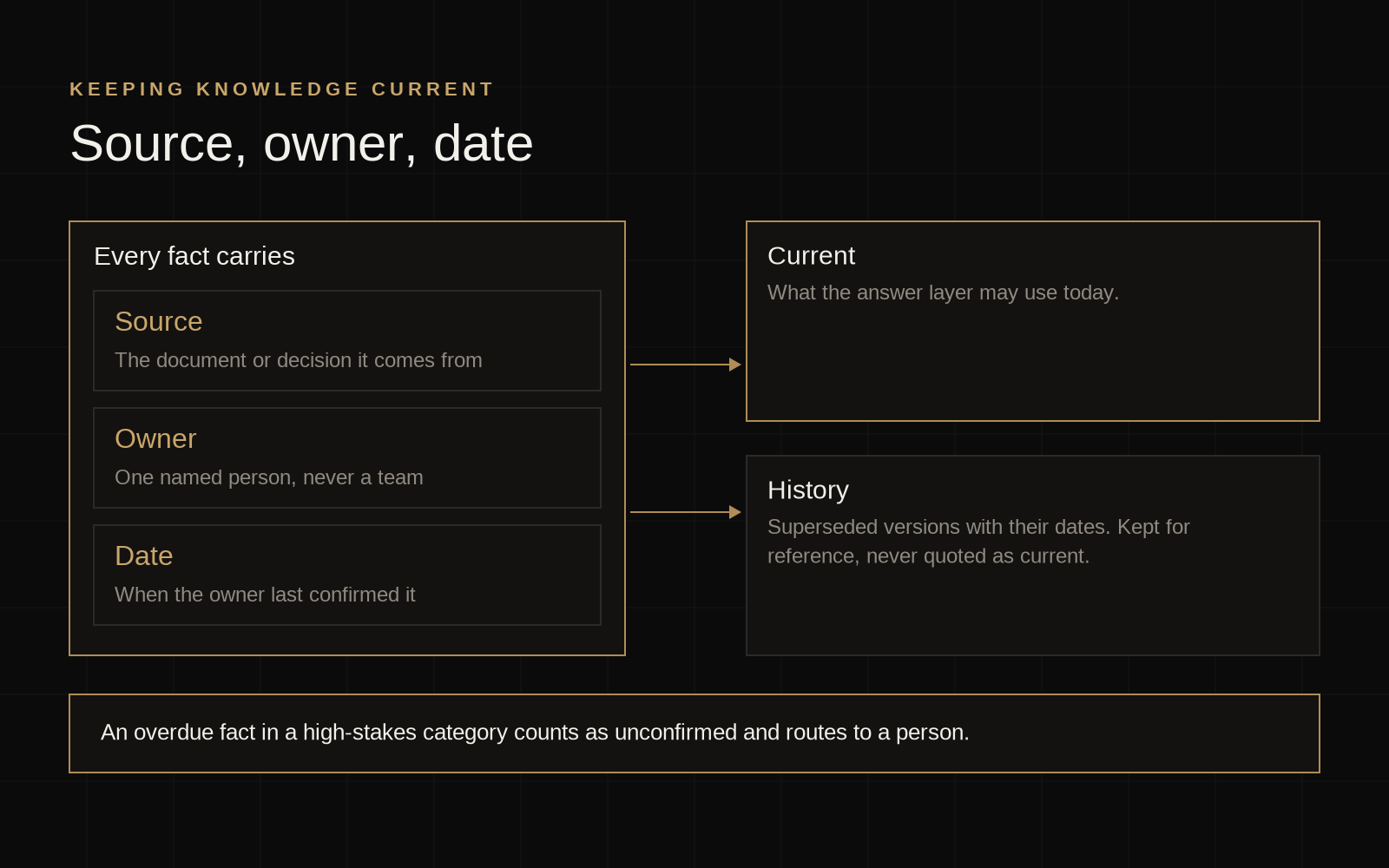
A fact is any statement the system may repeat to a customer: a price, a return window, an eligibility rule, a product limit. Each one carries three fields.
| Field | What it holds | Why it matters |
|---|---|---|
| Source | The document or decision the fact comes from | Someone can check it, and the answer can cite it |
| Owner | One named person accountable for the fact | A wrong answer has somewhere to go |
| Date | When the owner last confirmed it | Age is visible, and review has a trigger |
These are the properties of what we call a company brain: every fact has a source, an owner and a date, history is separated from current truth, and access follows your rules.
Owners are people, never teams. A team name means nobody answers when the fact is wrong.
Separate history from current truth
Your old policies hold value as history. They explain past tickets and past contracts. They cause damage when the system quotes them as current.
Keep two sets:
- Current. The facts the system may use to answer today's questions.
- History. Superseded versions, kept with their dates and the date they were replaced, readable for reference and unavailable to the answer layer for current questions.
When a customer asks about a policy that applied to a past purchase, the system can consult history with the dates attached. For every other question, it reads current only.
Set a review cadence
Review dates keep dated facts from rotting. Set the cadence by how fast each type of fact changes and how costly it is to be wrong.
| Type of fact | Example | Suggested cadence |
|---|---|---|
| Pricing, eligibility, money rules | Refund windows, fees | Monthly, plus on every change |
| Product behavior and limits | Feature rules, supported versions | On each release, plus quarterly |
| Process and contact details | Hours, escalation contacts | Quarterly |
| Stable reference | Company background | Twice a year |
Treat these as starting points, then tighten them where errors have cost you. A fact past its review date shows as overdue, and the system treats an overdue fact in a high-stakes category as unconfirmed, which routes related questions to a person.
Flag conflicts
A conflict is two current facts that cannot both be true: a help article with a 30-day window and a contract template with a 14-day window. Conflicts arise constantly in a growing company.
Handle them by rule:
- The system detects or a reviewer reports the conflict.
- The conflict is flagged to the owners of both facts, with both sources attached.
- The owners agree which is correct. If they cannot, the person who owns the policy decides.
- The losing fact is corrected or moved to history.
- A test question for the case is added to the test suite.
Until the conflict is resolved, questions that touch it escalate to a person. The system never picks one at random.
What happens when a policy changes
A change has a path. Write it down so it runs without heroics.
- Decision. The policy owner records the new policy, the effective date and what it replaces.
- Update the fact. The owner edits the current fact with the new source and date.
- Move the old version to history. Keep its dates.
- Find the dependents. Search for every fact, template and test question that references the old policy.
- Update the tests. Affected test questions get new verified answers, signed off by the owner.
- Rerun the suite. The change releases only when the suite passes.
- Tell the people. Staff who handle escalations learn the change on the effective date.
The test suite is what makes step 6 meaningful, and the guide on how to test an AI knowledge system before launch covers building it.
The weekly upkeep procedure
Run this once a week with the person who coordinates knowledge, typically a support operations lead. It takes under an hour once the habit forms.
- Overdue list (10 minutes). Open the facts past their review date. Assign each to its owner with a due date this week.
- Conflict list (10 minutes). Review open conflicts. Chase owners for decisions.
- Change log (10 minutes). Review policy decisions made this week and confirm each has run the change path.
- Corrections (10 minutes). Review corrections made by human reviewers. Confirm each cause was fixed at the source and added to the test suite.
- Escalation reasons (10 minutes). Look at the top reasons the system escalated. Missing sources and unconfirmed facts show up here first.
- Test run (5 minutes). Confirm the full suite ran and passed after this week's changes.
- Record (5 minutes). Note what changed and who owns the open items.
The record becomes part of the audit trail.
What goes wrong
- Owners are teams. A fact owned by "Support" is owned by nobody. Name a person.
- Dates are set once and never updated. The date field must change when an owner confirms the fact, even when nothing else changes.
- Policy changes skip the path. Someone updates the help page and forgets the contract template. The dependents search in step 4 exists for this.
- History is deleted. Old versions disappear and a past dispute cannot be resolved. Keep history, mark it and exclude it from current answers.
- Review is skipped in busy weeks. The overdue list grows. Protect the weekly slot and assign a backup coordinator.
- A departing owner leaves no handoff. Reassign facts when anyone leaves a role.
Questions leaders ask
How many facts will we have?
Count the facts behind your most common question types first. A fact is any statement the system may repeat. Start with those and widen as new question types go live.
Who coordinates all this?
One person coordinates and the owners own the facts. Support operations or knowledge management usually fits. The coordinator chases, and the owners decide.
Does this slow down policy changes?
The change path adds a few steps, and each takes minutes. The alternative is a policy that changed on paper while customers keep hearing the old version.
What does the system do when a fact is overdue?
For low-stakes facts it answers and shows the age to the reviewer. For high-stakes facts it treats the fact as unconfirmed and escalates related questions. You set the rule per category.
For the full system around this routine, read AI Knowledge Systems for Customer Support.
The Leverage Diagnostic takes about six minutes, scores the six places leverage hides and prices the gap with the math shown, including how much of your company knowledge sits without an owner.