Buy AI knowledge base software when your questions are high volume, your answers change slowly, a wrong answer costs little, and your needs fit what the product already integrates with. Build a custom system when answers change often, a wrong answer is expensive, the integrations run deep, or you need to own the data and the audit trail. Many companies do both: buy the commodity layer and build the governed core.
If you are a COO and a CTO deciding together, you each own a different risk. The COO owns the cost of a wrong answer. The CTO owns the cost of carrying the system. This guide gives you five criteria, a scoring procedure you can finish in one meeting, and a hybrid path.
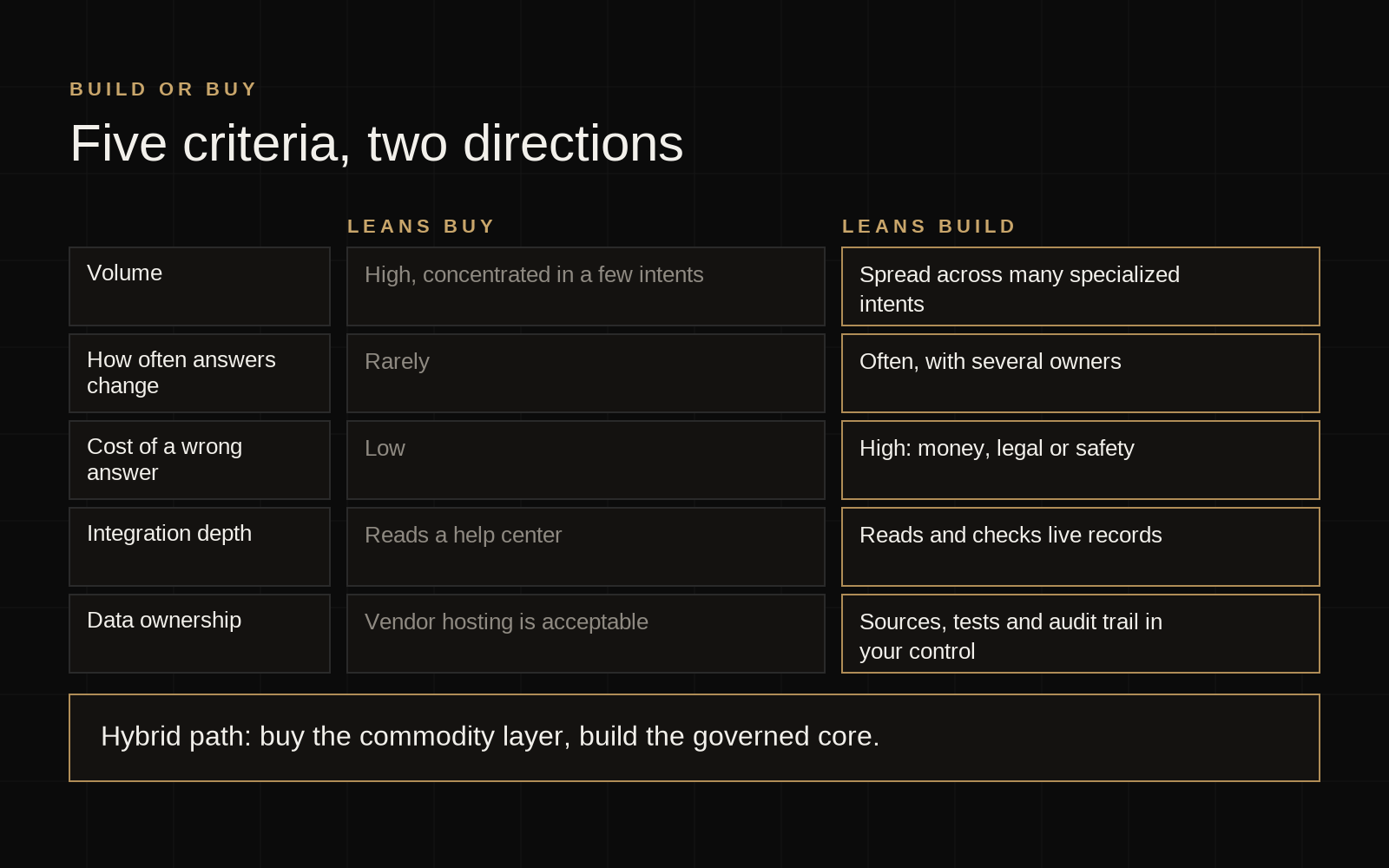
The five criteria
Volume
How many customer questions do you receive each month, and how concentrated are they? High volume concentrated in a small number of intents favors software, because a packaged product handles common questions well. Spread-out volume across many specialized intents favors a custom build.
How often answers change
If your policies, prices or eligibility rules change monthly, the work of keeping answers current dominates. A system needs owners, dates and a way to separate history from current truth. Check whether a product supports that, or whether it indexes files and leaves currency to you.
Cost of a wrong answer
A wrong answer about a store's opening hours costs little. A wrong answer about a contract term, a refund exception or a regulated product costs money and trust. The higher the cost, the more you need a test gate, escalation by design and an audit trail you control.
Integration depth
Does the system only read a help center, or must it check an order, a contract or a customer record before answering? Reading is simple. Acting on live records requires integration with your systems of record and guardrails in code.
Who owns the data
Consider where your sources, your correction history and your test suite live. They are the accumulated knowledge of your company. Decide whether you want that asset sitting in a vendor's system or in yours, and what leaving would cost.
The decision table
| Criterion | Leans buy | Leans build |
|---|---|---|
| Volume | High, concentrated in a few intents | Spread across many specialized intents |
| How often answers change | Rarely | Often, with several owners |
| Cost of a wrong answer | Low | High (money, legal, safety) |
| Integration depth | Reads a help center | Reads and checks live records |
| Data ownership | Vendor hosting is acceptable | You need the sources, tests and audit trail in your control |
A scoring procedure for one meeting
- Put the five criteria on a whiteboard with the COO and CTO both present.
- For each criterion, each person scores your situation from 1 (leans buy) to 5 (leans build) in writing, without discussion.
- Reveal the scores together. A gap of two or more points on any criterion goes to discussion first, because it means the two of you see the situation differently.
- Weight each criterion from 1 to 3 by how much it would hurt if you got it wrong. Cost of a wrong answer usually gets a 3.
- Multiply, add up, and divide by the total weight. A score under 2.5 points toward buying. A score over 3.5 points toward building. Between them points toward the hybrid path.
- Write the result and the reason on one page. Revisit it when volume, answer change rate or regulation shifts.
The thresholds are a starting point. If you disagree with them, change them before you score and write the change down.
The hybrid path
The hybrid path splits the system by layer.
- Buy the commodity layers. Chat interface, ticketing integration, basic analytics and hosting often come well packaged.
- Build the governed core. Sources with owners and dates, the intent classifier, the test suite, escalation rules and the audit trail are specific to your company and carry the risk.
- Keep the seam clean. The governed core exposes answers through a defined interface, so you can swap the software around it without losing the knowledge.
The reason to own the core: the sources, owners, test suite and correction history are your company's knowledge, and they keep their value whichever interface sits on top. For one client we built the governed core from 7,519 historical question-and-answer records, with three layers of escalation and an AI intent classifier. It passed a 370-question test suite before launch, and that suite runs against every change.
The company brain page describes the properties worth owning.
Questions to put to any vendor
- Can I see which source produced each answer, with its owner and date?
- How does the product separate old policy from current policy?
- How do I run my own test suite against it, and how do I rerun it after a change?
- What happens when two sources conflict?
- How do access rules apply at retrieval?
- Can I export my sources, corrections and test results?
- How does a human reviewer correct an answer, and where does the correction go?
A vendor who answers clearly and shows it live passes. A vendor who answers in general terms tells you something too.
What goes wrong
- Buying before choosing an owner. Software arrives and nobody owns the sources. Name the owners first.
- Building what a product already does. A custom chat widget adds cost and no advantage. Spend custom effort on governance.
- Deciding on a demo. Demos show the best questions. Ask to run a sample of your own historical questions through any product.
- Ignoring exit costs. Corrections and tests accumulate inside a vendor's system. Ask about export before signing.
- Skipping the hard cases in the trial. A trial on easy questions hides the differences. Include changed policies, conflicts and refusals.
- Scoring alone. The COO scores one way, the CTO another, and the gap is never discussed. Use the blind-then-reveal step.
Questions leaders ask
Is building always more expensive?
It depends on volume and scope. Software has license and usage costs that rise with volume, and a custom build has a larger upfront cost with different carrying costs. Model both over the period you will actually use the system. The guide on cost and return lists the cost drivers.
Can we start with software and move to custom later?
Yes, provided you keep your sources, corrections and test suite in a form you own. That keeps the move open.
Who should make the final call?
The two of you together, with the head of support in the room. Support carries the day-to-day result, so their view on quality belongs in the decision.
Does this change if we have strict compliance needs?
It pushes toward build or hybrid, because audit trails, access rules and data location become requirements and your control over them matters more.
The overview in AI Knowledge Systems for Customer Support shows how the parts fit together.
If you want a concrete first step, the 30-Day Leverage Pilot runs the build path on one workflow in four weeks and ends with a day-30 decision to continue or stop, so you test the build option against real questions before committing.