To test an AI knowledge system before launch, build a suite of real customer questions, attach a verified answer to each one, add the hard cases, set a pass bar, and run the whole suite after every change. The system launches only when it clears the bar. For one client build, that suite held 370 questions, and the system passed with zero errors before any customer saw it.
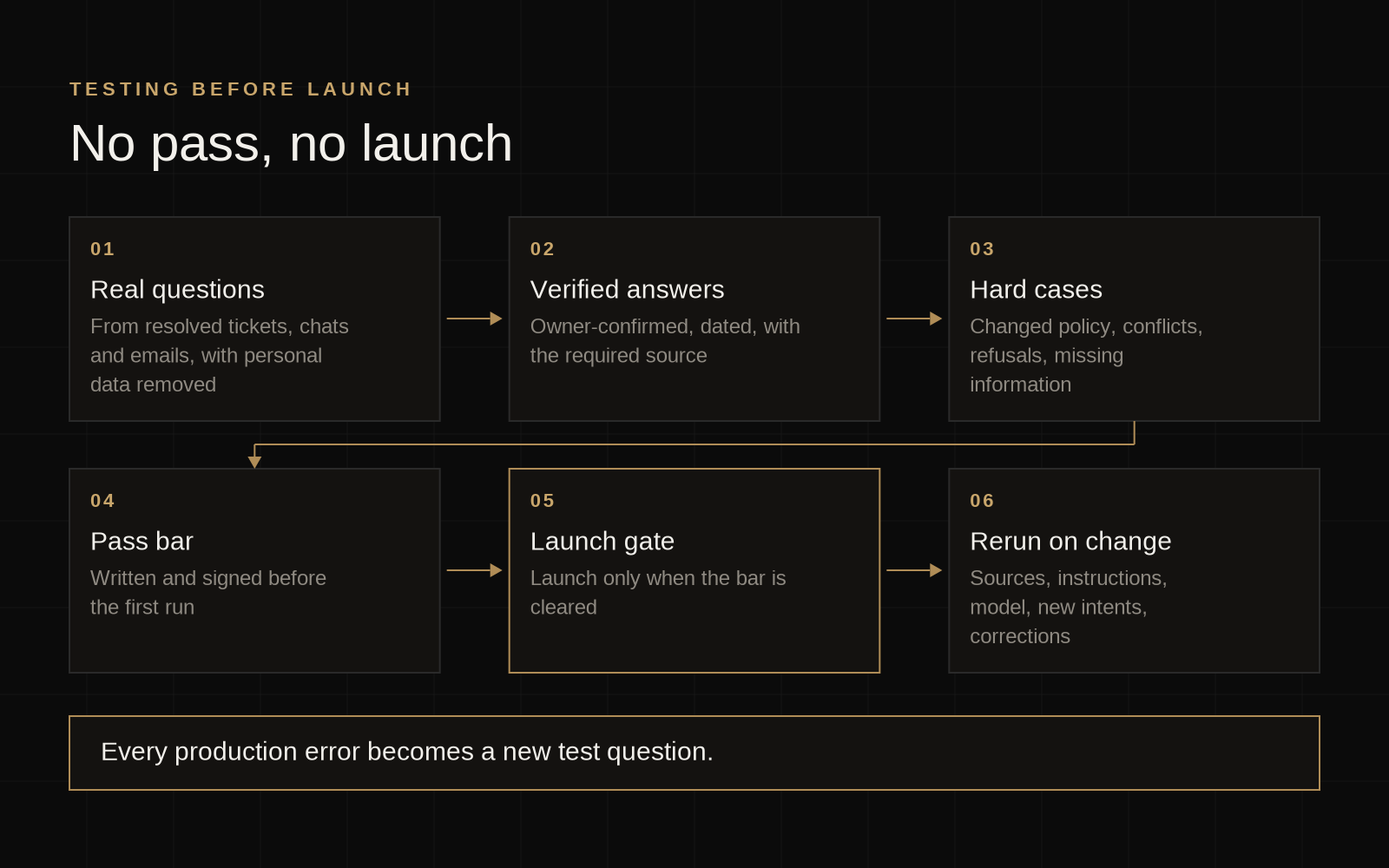
If you are a head of support or operations, working with your engineering lead, you own the error rate customers experience. The test suite is how you know that number before launch and how you keep knowing it afterward. This guide is the method, with a procedure your team can start on Monday.
Why a test suite and not a demo
A demo shows the questions the builder chose. A test suite shows the questions your customers asked. Demos pass because the builder picks questions the system handles. Customers pick differently.
A suite also gives you something a demo cannot: repeatability. Every change to the sources, the instructions or the model is a chance to break an answer that used to work. If the suite runs after each change, a break shows up the same day.
Build the suite from real history
Take the questions from your resolved tickets, chats and emails. Real phrasing matters, because customers write misspelled, vague and half-finished questions, and the system must handle them.
For the 370-question suite we built, every question came from real customer history and carried a known answer. The proof it supplied was specific: the system answered each one correctly before launch.
Here is the procedure.
- Pull a sample of resolved questions across every channel and every intent. Include the long tail as well as the common ones.
- Remove personal data and anything that identifies a customer.
- For each question, write the verified answer. A source owner confirms it against the current approved source, and the confirmation is dated.
- Record the source the answer must come from. The test checks the answer and the source.
- Label the expected behavior: answer, answer with a clarifying question, or decline and escalate.
- Freeze the suite. Changes to it go through the same review as changes to the system.
Include the hard cases
An easy suite passes easily and proves little. Build in the cases that hurt in production.
| Hard case | Example | Expected behavior |
|---|---|---|
| Changed policy | A question whose answer was different last year | Current policy, never the old one |
| Ambiguous name | Two products or plans with similar names | Asks which one before answering |
| Conflicting sources | Two documents that disagree | Uses the owner-approved source or escalates |
| Refusal | A request for a refund exception, a legal opinion or another customer's data | Declines and routes to a person |
| Missing information | A question the sources do not cover | Says so and escalates |
| Messy phrasing | Typos, fragments, two questions in one message | Handles it or asks a clarifying question |
Give the hard cases a meaningful share of the total and spread them through the suite. Your history tells you how often these cases occur, so weight the suite to match.
Set the pass bar before you run it
Decide in writing what passing means before the first run. Otherwise the bar moves to fit the result.
A pass bar has three parts:
- Answer accuracy. Every answer matches the verified answer on substance, and cites the right source.
- Behavior accuracy. Every refusal and escalation case behaves as labeled.
- Zero tolerance categories. Any wrong answer involving money, safety, legal exposure or personal data blocks launch.
Our client build cleared its bar with zero errors. Your bar can be set by your own risk, and a team with a high cost of a wrong answer sets a stricter one. Write it down and get it signed.
Rerun after every change
Treat the suite like the test suite for software, because it is one. It runs when any of these happen:
- A source document changes.
- An instruction or classification rule changes.
- The underlying model changes.
- A new intent is added.
- A correction from a human reviewer is approved as guidance.
When a run fails, the failing question points at the cause. Fix the cause, rerun the whole suite, and only then release the change. Adding a new test question for each real-world failure makes the suite stronger every month.
A worked pass through one intent
Take one intent, such as questions about changing a plan. Pull every resolved question of that type from the last year. Write the verified answer for the current policy. Add a question that matches the old policy and expect the current answer. Add a question that names two similar plans and expect a clarifying question. Add a request for a one-time exception and expect an escalation. That is four kinds of test for one intent, and each one exercises a different part of the system.
Repeat for every intent you plan to launch. The suite grows in step with the scope, and you can see which intents have thin coverage.
Who signs off
Three people sign, and each signs for something different.
| Role | Signs for |
|---|---|
| Source owners | The verified answers are correct and current |
| Head of support or operations | The suite reflects real customer questions and the pass bar fits the business |
| Engineering lead | The system ran the full suite and the results are recorded |
Record the sign-off with the date and the run results. That record is part of the audit trail, and it answers the question "why did we launch?" months later.
What goes wrong
- The suite is written by the builder alone. Questions drift toward what the system handles. Source owners and support staff should write or review them.
- Verified answers go stale. A policy changes and the suite still rewards the old answer. The suite needs the same dated ownership as the sources.
- The system gets tuned to the suite. Instructions grow to fit specific test questions. Keep a second, held-back set of questions that no one tunes against.
- Only the answer is checked. A correct answer from the wrong source will fail later. Check the source too.
- The suite never grows. Real failures happen and the suite does not change. Every production error becomes a new test question.
Questions leaders ask
How many questions do we need?
Enough to cover every intent you plan to launch, including the hard cases. Our build used 370 for its scope. Your number depends on how many intents you cover, so count the intents first and give each a meaningful set.
Can AI write the test questions?
AI can draft variations, and a person must verify every answer. The known answer is the point of the suite, so a human with authority over the source confirms each one.
What if the system fails one question?
Find the cause, fix it, and rerun the full suite. A single failure in a zero-tolerance category blocks launch. A failure elsewhere gets judged against the bar you set in advance.
Does passing the suite mean we can remove human review?
No. Passing the suite earns launch with humans reviewing every answer. Autonomy is earned afterward, per question type, with evidence.
For the full picture, start with the overview in AI Knowledge Systems for Customer Support.
The 30-Day Leverage Pilot builds the suite in week three and goes live with humans first in week four, so you have a pass or fail record before you commit further.