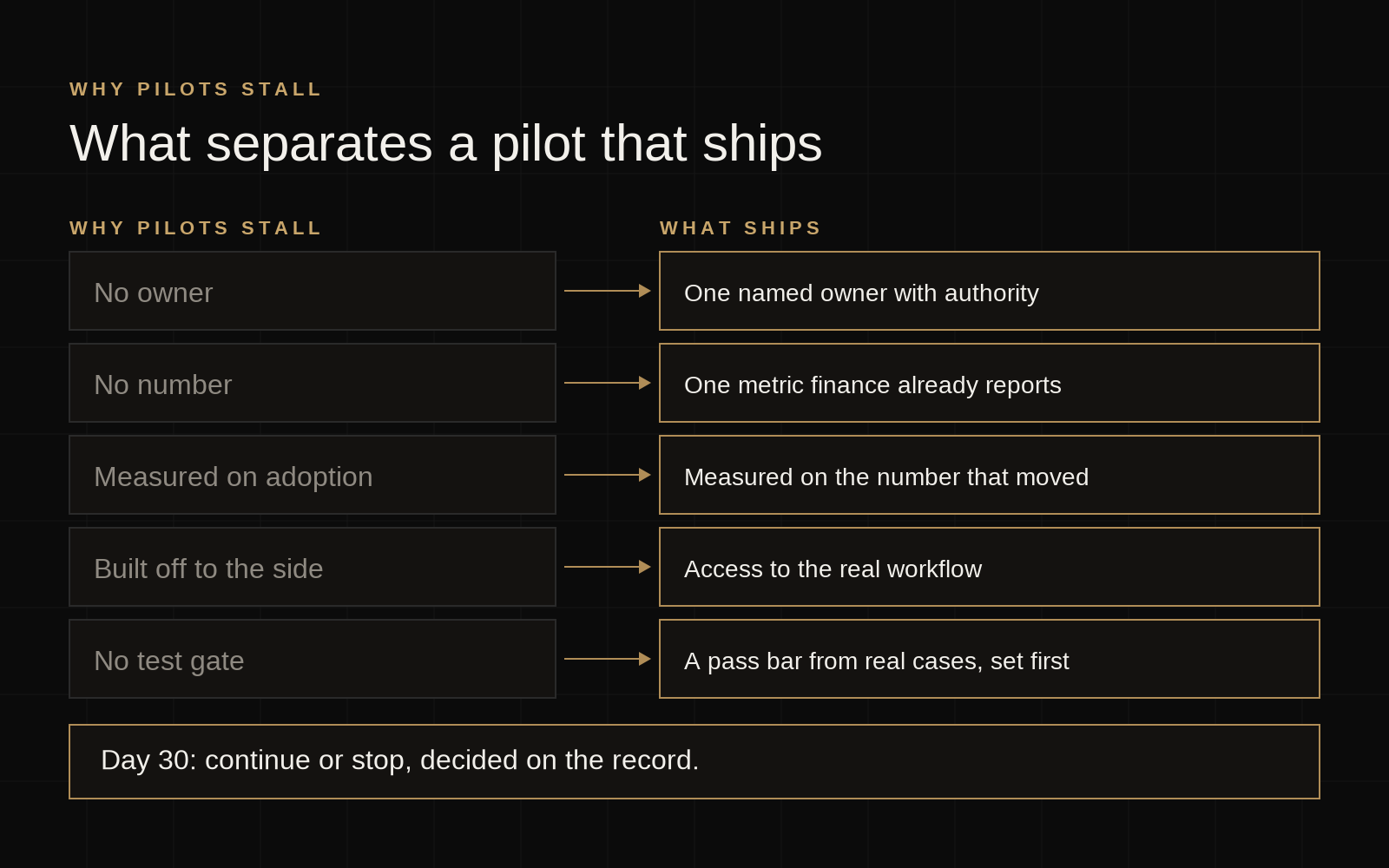
AI pilots stall because they lack an owner, a number, a connection to real systems and a test gate. A pilot that ships has one named owner, one metric the finance team already reports, access to the real workflow, and a pass bar set before the build starts. A 30-day scope with a continue-or-stop decision on day 30 keeps it honest.
This guide is for the COO or the executive who owns the AI program. The number you own is the share of pilots that become live systems doing real work. This guide is about raising it.
Why pilots stall
Five causes account for most stalled pilots. Look for them in your own list of experiments.
No owner
The pilot belongs to a working group. Everyone has an opinion and nobody has the authority to change how work flows. When the pilot needs a decision from sales, finance and legal, it waits.
No number
The goal is "explore what AI can do." There is no figure to move, so there is nothing to compare against at the end. A pilot with no number cannot succeed or fail, so it drifts.
Measured on adoption
The team reports how many people tried the tool. Adoption shows people are willing. It leaves open whether the work changed. An hour saved by one person is just an hour. It disappears into the rest of the week.
Built off to the side
The pilot runs in a sandbox with sample data, apart from the systems where the work happens. It looks good in a demo. When it is time to connect to the real workflow, the integration work turns out to be most of the project, and nobody planned for it.
No test gate
There is no agreed standard for "good enough." The team argues about quality by anecdote. Without a pass bar built from real questions with known answers, no one can say yes, and no one dares say no.
Notice that none of the five is a model problem. They are management problems, and they are fixable in the scoping stage.
How to scope a pilot that ships
Start from the money. Pick one workflow where a customer feels the delay, or where staff time goes to repeated questions, or where revenue waits on a manual step. Name the number it moves, the person who owns that number, and the baseline today.
The three ways to grow are more customers, larger transactions and more frequent transactions. A good pilot attaches to one of them, or to the cost of serving them.
The four weeks
I run the 30-Day Leverage Pilot in four weeks. You can use the structure whether or not you work with us.
| Week | Focus | What you have at the end |
|---|---|---|
| 1 | Find the lever | One workflow, one number, one owner, a baseline |
| 2 | Map the constraint and the knowledge | Where work waits, which facts and rules the system needs, with sources and owners |
| 3 | Build and test | A working system that passes a test suite of real cases with known answers |
| 4 | Live with humans first | Real traffic, every answer reviewed by a person, a record of results |
Day 30 is the decision: continue or stop.
Week 1: find the lever
Follow one real item through the workflow from start to finish, and split the time into working and waiting. The waiting is the map. Write down the baseline: how long it takes, how many people touch it, how often it goes wrong.
Week 2: map the constraint and the knowledge
Identify the single step that limits the whole workflow. Then list the facts, rules and examples the system will need. Each fact gets a source, an owner and a date. If the knowledge is scattered or stale, you have just found the real work.
Week 3: build and test
Build against the real systems with read access, or the closest safe equivalent. Assemble the test suite from real cases with answers your experts have confirmed. Run it, find the failures, fix them, run it again. The pass bar was set in week 1 and does not move.
Week 4: live with humans first
Put the system in front of real work with a person reviewing every output. Track accepted, edited and rejected. Track time saved on the number you chose. Hold a short review each day with the owner.
Exit criteria to write down on day one
Write these before the build starts, and have the owner sign them.
- The metric, its baseline and the target.
- The test suite pass bar, for example the share of known-answer cases that must be correct.
- The review rule: who reviews, how many outputs, for how long.
- The failure triggers that pause the pilot, such as a wrong answer reaching a customer.
- The data and systems the pilot may touch.
- The date of the day-30 decision and who makes it.
The day-30 decision
On day 30, the owner and the executive sponsor look at the record and choose.
| Evidence | Decision |
|---|---|
| Metric moved toward target, test bar passed, reviewers accepting most outputs | Continue: widen traffic, relax review by question type |
| Metric moved, test bar not yet passed | Continue for a fixed extension with named fixes, or stop |
| No movement on the metric after live traffic | Stop and write down what was learned |
| Pass bar met but the owner cannot name who acts on the output | Fix ownership before continuing |
Stopping is a legitimate result. A clear stop with a written reason saves months of drift, and it tells you where the next attempt should aim.
Rolling the pattern to the second team
The second team starts faster because the first one left assets behind. Carry over four things.
- The test suite format and the pass bar template.
- The knowledge structure: every fact with a source, an owner and a date.
- The review and escalation rules.
- The governance set described in the guide on AI governance for mid-market companies.
Do not copy the first team's system. Copy the method, and let the second team find its own lever and its own number. A shared company brain lets each new workflow reuse the facts the earlier ones already verified.
What goes wrong
- The pilot has two owners. Each assumes the other will decide. Name one.
- The baseline was never measured. At day 30 the team believes things improved and cannot show it.
- Scope grows in week 3. A second workflow joins and neither finishes. Keep one workflow until the first is live.
- The pass bar moves. The suite fails, so the bar is lowered. Set it in week 1 and keep it.
- Knowledge is out of date. The system answers from a policy that changed last quarter. Assign owners and review dates in week 2.
- Live traffic skipped. The pilot ends on a demo. A pilot that never meets real traffic has not been tested.
- The result has no home. The pilot works and nobody has the budget to run it. Decide who funds it before day 30.
For the engineering side of reaching production, see the pillar guide on engineering AI for production.
Questions leaders ask
Why 30 days?
Thirty days is long enough to build and test one workflow against real cases, and short enough that nobody loses sight of the question. A longer pilot tends to collect extra goals. A fixed window forces the scope down to one lever.
What if the pilot shows no result?
Stop it, and write down why. The cause might be the workflow chosen, missing knowledge or the wrong number. Each of those is useful, and the next pilot starts with that knowledge.
Who should lead it?
An executive with authority across the teams the workflow touches, with an engineer or technical lead doing the build. The owner is the person who answers for the number, and that person is rarely the one writing code.
How do we avoid running ten pilots at once?
Rank candidates by the money at stake and the clarity of the constraint, then run one. When it ships, the second goes. Parallel pilots dilute attention and review capacity.
The next step is the 30-Day Leverage Pilot itself. Read how the four weeks run and what you receive on the 30-Day Leverage Pilot page.