Sit in enough leadership meetings and you will hear the same report. Adoption is up. Most of the team uses AI every day. People say it saves them an hour, maybe two.
Then ask the only question that matters: where did those hours go?
The room gets quiet, because nobody knows. Revenue per employee looks the same. Proposals take as long as they did last year. Support still needs the headcount it needed before.
This is the strangest moment in the AI story. The tools are extraordinary, your people are using them, and the company feels exactly as it did.
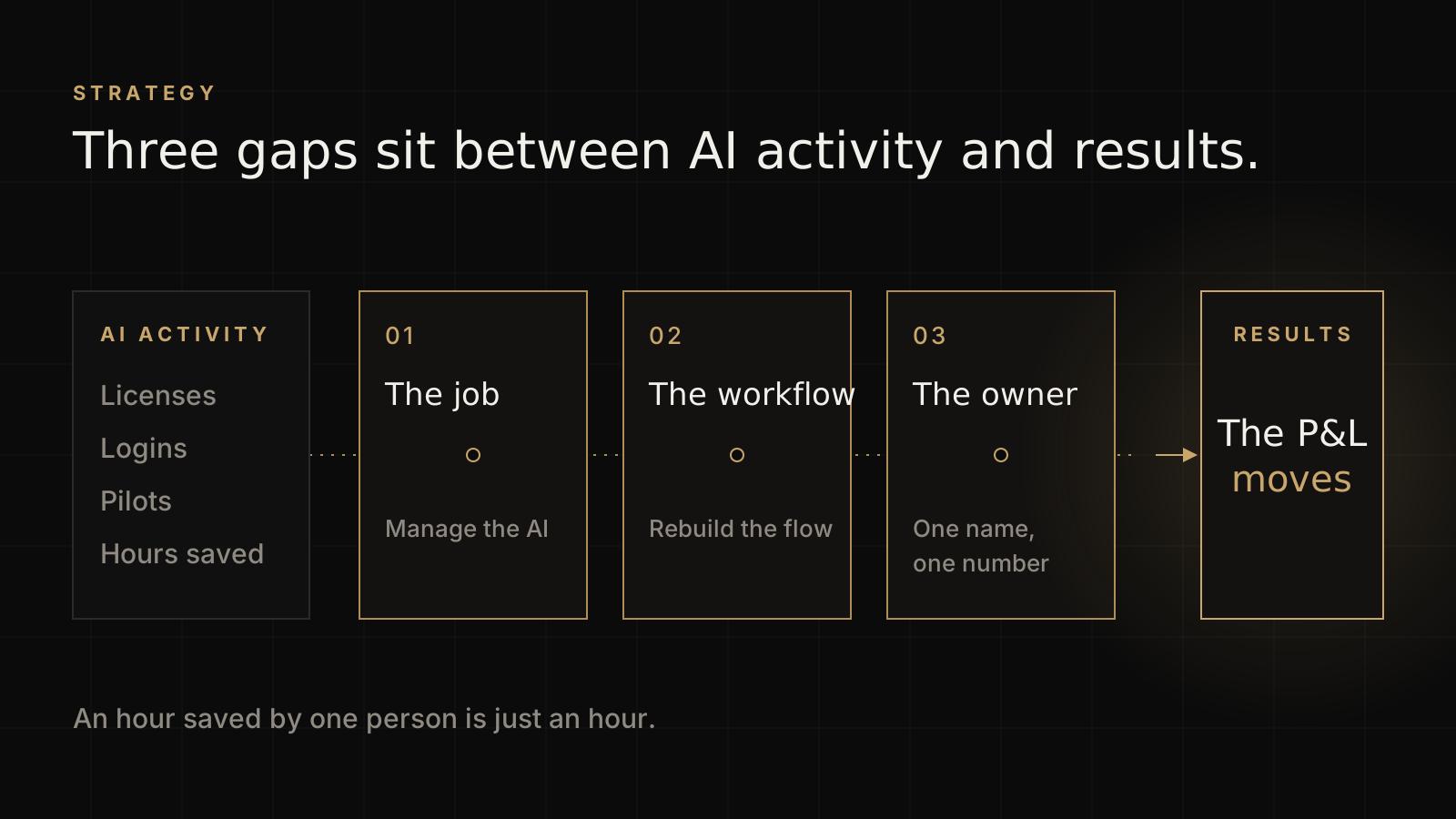
Your people are fine and so are your tools. The trouble is arithmetic. An hour saved by one person is just an hour. It slides into the rest of the week and disappears. A company changes only when the work itself changes, and that takes three things most companies have skipped.
Gap one: people are still doing the old job
Most people use AI as a faster pair of hands. They keep the job they had and ask for help with parts of it.
The better picture is that every capable person in your company now runs a small team. The direct reports happen to be software. They are fast, tireless and occasionally wrong with total confidence. Running them is management work: give a clear brief, check the output, correct the error, and make sure the same error never comes back.
That last step is where the value compounds, and it is the one almost everyone skips.
Watch what happens at your company when AI gets something wrong. Someone fixes the output, sends it and moves on. The lesson dies in a chat window. Tomorrow a colleague hits the same mistake and fixes it again. You are paying for the same correction over and over.
A good manager handles this differently. When a new hire makes the same mistake twice, a good manager changes the training. Do that here. Turn each repeated correction into a shared rule: a written standard, an approved answer, a better instruction that everyone's AI reads. One person's fix now protects the whole company, and each cycle costs less than the one before it.
This raises the value of your experts. AI is quick, but it carries no accountability and has no memory of the client who nearly left three years ago. Your best people know which answer would embarrass you. Until now they applied that judgment one piece of work at a time. Written into the system, it applies to all of them.
Gap two: you sped up the steps and kept the workflow
Take a proposal. Say it takes one day to write and nine days to clear pricing and legal. Ten days from request to customer.
Hand the writer AI and the draft takes an hour. Everyone celebrates. The writing just got eight times faster, and the customer gets the proposal one day sooner.
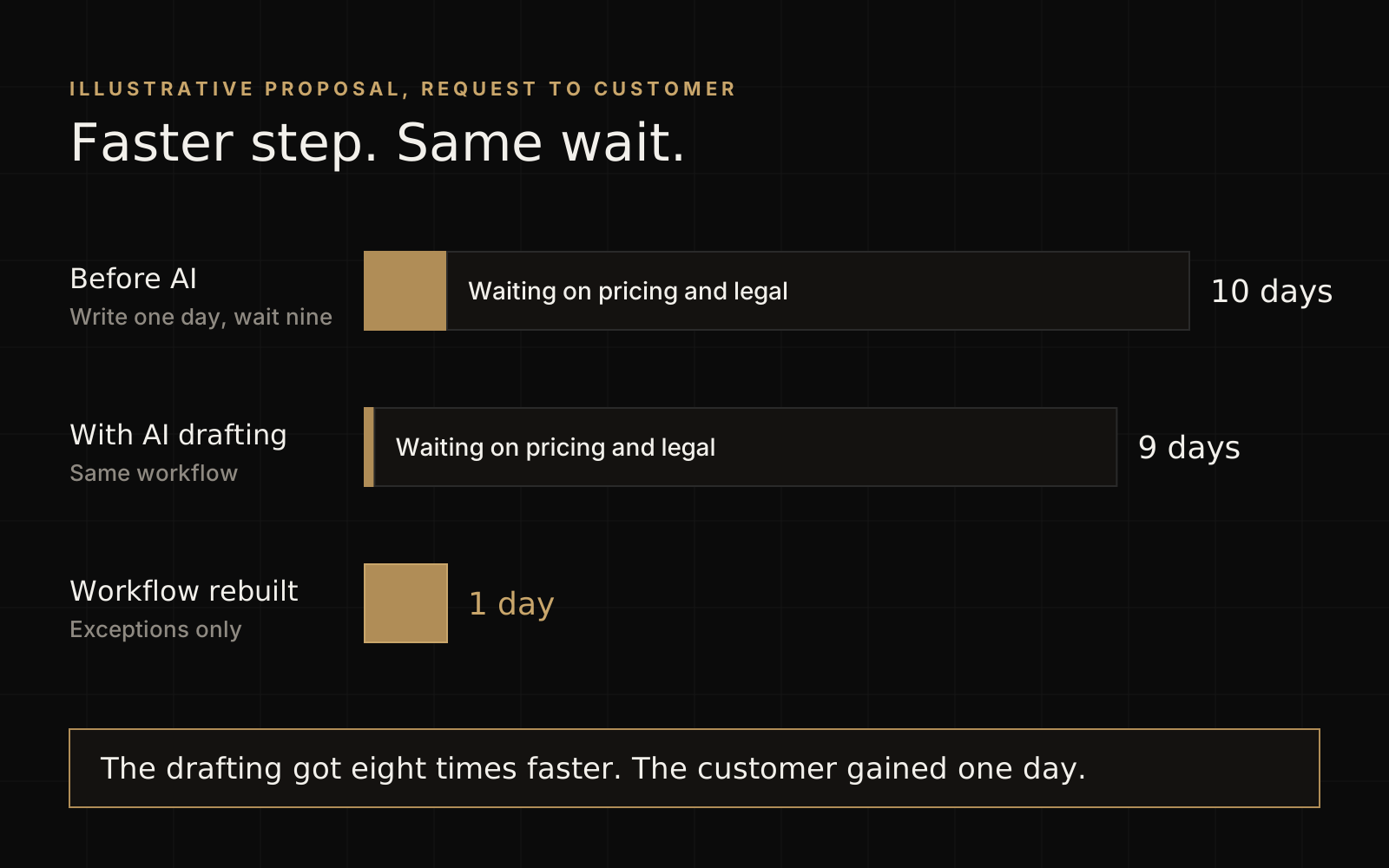
A process moves at the speed of its slowest step, so speeding up any other step changes almost nothing. Often it makes things worse, because more work now piles up in front of the same queue.
Now rebuild the workflow. Pricing rules go into the system. Standard terms get approved once, in advance. Only the true exceptions reach a person, with the context attached. The proposal goes out in a day, and your legal team spends its time on the deals that need a lawyer.
That is the difference between the two stages of AI in a company. In stage one, AI sits inside the workflow you already have. Nearly everyone is here. In stage two, you redesign the workflow around what AI makes possible, and the question changes from "how do we do this step faster?" to "if we designed this today, would this step exist?"
Expect the bottleneck to move. Clear the approval queue and the delay shows up in data quality, or a handoff, or review. That is what progress looks like. The constraint moves, and you move with it.
The platform I architected at Level 3 and Lumen went from $0 to $500 million in four years, and faster typing had nothing to do with it. The system changed which account reached which person, at which moment, with which offer, across more than 1,000 product lines. The work itself changed, so the result did.
Gap three: nobody owns the company-level change
One person can adopt a tool by lunchtime. No one person can rebuild an approval chain that runs through sales, finance and legal. That work crosses budgets and org charts, and it competes with everything already on the roadmap. So it waits for someone with the authority to decide.
Meanwhile, the company fills with quiet heroes. A sharp analyst in finance builds something brilliant. A support lead writes a superb set of instructions. Each win stays where it started, because spreading it is nobody's job.
Many companies cannot even say where their work waits, because nobody has measured it. You cannot remove a bottleneck you have never seen.
Experimenting was the right call for a while. Everyone needed to learn what these tools could do. That phase has done its work, and what comes next is a decision: one named leader, one number the CFO already reports, the budget and authority to change how work flows across teams, and a regular review in front of the CEO.
Without that decision you get pilots. With it you get a system.
What stays the same
It would be easy to read all this as permission to move fast and worry later. I read it the other way.
I built message-switching software serving the FBI, the DOJ and state law enforcement agencies. The rule from that work still holds: assume every part will fail, and decide in advance what happens when it does. When output becomes cheap, checking it becomes the valuable work.
Documentation, testing and clear ownership all matter more now, because AI reads your documents and acts on them. The economics have also moved in your favor. Tests that were once too expensive to write are now cheap, so you can afford to check far more than you used to.
When my team built a company brain from 7,519 historical customer questions, it had to answer 370 test questions before launch. It passed with zero errors, and it now answers more than half of the questions that used to need a person. The speed came from AI. The trust came from the test.
If you run a smaller company
Everything above applies to you, and you hold one real advantage: you can decide today.
- You are the owner. Gap three closes the moment you say so. There is no committee to convince.
- Pick one workflow your customers feel. Quoting, onboarding or follow-up is usually the place to start.
- Keep one shared document of rules that your AI reads. Every repeated mistake goes into it. That document is the first version of your company brain.
A large company can spend a quarter changing an approval chain. You can do it by Friday.
Three things to do this month
Each of these takes under an hour, and none of them requires buying anything.
- Follow the corrections. Ask five people for the last mistake AI made in their work, then ask where the fix went. If the answer is "I fixed it," you have found gap one.
- Time one workflow. Pick a process a customer feels. Follow one real item from start to finish, and split the time into working and waiting. The waiting is your map.
- Name the owner. Write down one person and one number. If you cannot fill in both, start there.
When you want the wider view, the Leverage Diagnostic takes about six minutes, scores the six places leverage hides and prices the gap with the math shown. The AI Leverage Blueprint walks through the full method.
Your people have already done the first part. They picked up the tools. The rest belongs to leadership: change the job, change the work, and put one name on the result.