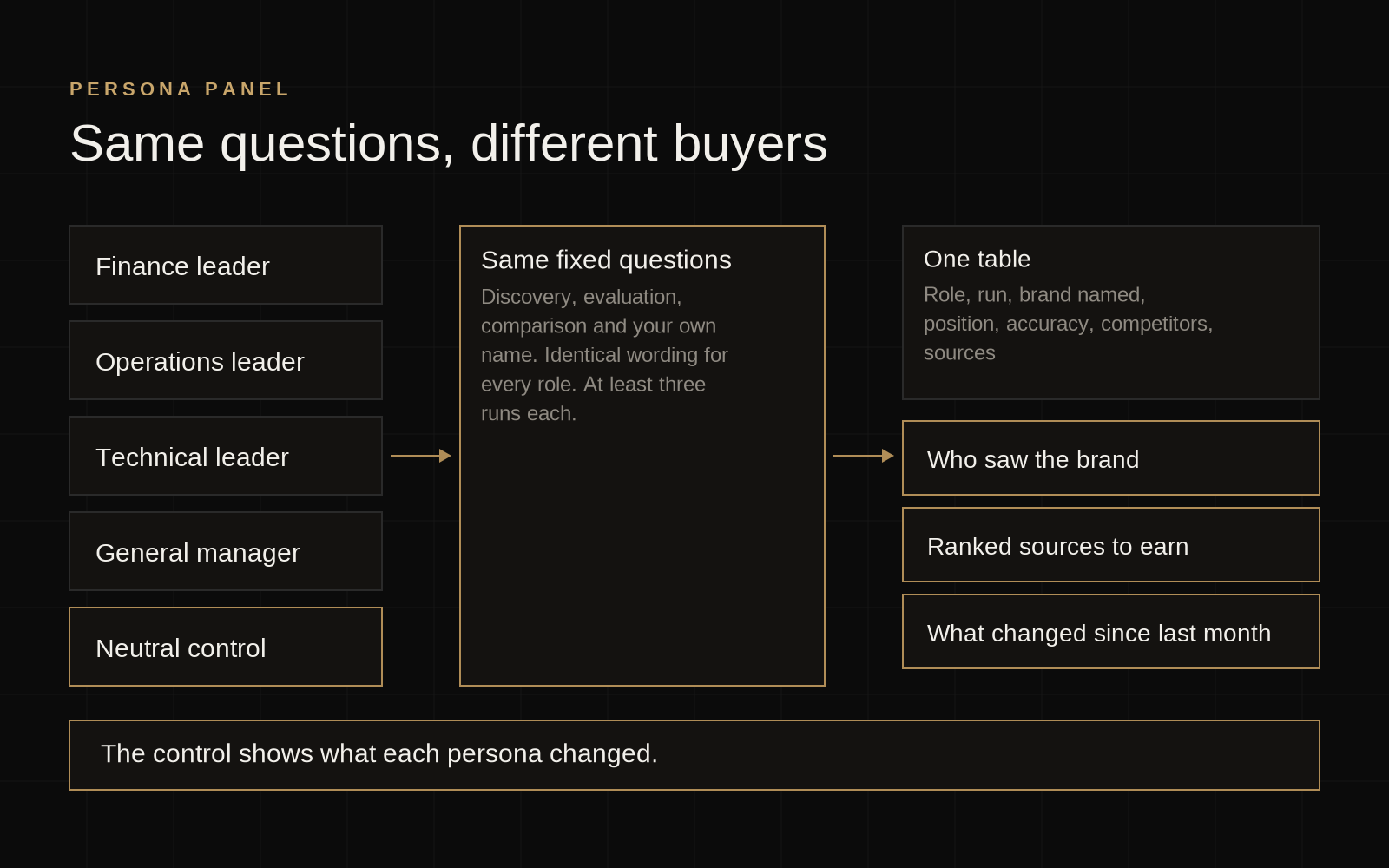
AI assistants can give different answers to the same question depending on who seems to be asking. A CFO and an operations lead may see different companies named, different sources cited and different descriptions of you. A persona panel measures this: a fixed list of buyer questions, asked from each buyer's point of view, plus a neutral control, every month, in one table.
This guide is for the CMO or head of marketing at a company where a buying committee decides. The number you own is the share of committee members who meet an accurate version of your company before sales ever speaks to them. A single generic check cannot tell you that number.
Why one generic check misses the problem
Most teams test their AI visibility by asking a question or two from one account and reading the result as the truth. That produces a single view, from a single imagined buyer.
Your real buyers are several people. A finance leader asks about cost, control and risk. An operations leader asks about implementation and disruption. A technical leader asks about security and integration. Each phrases questions differently, and each may be shown different companies and different sources.
If your visibility is strong for one role and absent for another, the generic check can hide it. The buyer you lose is often the one you never tested for, such as the committee member with veto power who never appeared in your measurement.
For the base method, read the pillar guide first.
What a persona panel is
A persona panel runs the same set of questions as several buyer types, side by side with a neutral control. The control is the same question asked with no buyer context. The difference between the control and each persona shows where the answer changes for that buyer.
The panel produces three kinds of evidence.
- Who saw your brand, and who did not.
- Which sources the assistant cites for each buyer type.
- What changed since last month.
An example from practice
For City National Bank, I built a persona-based AI search framework. A fixed panel of buyer questions is run through Google's AI Mode every month as different buyer types, for example a mid-market CFO and a business manager, alongside a neutral control. The differences show which sources AI cites for each buyer and where the bank is absent.
Each month the output has three parts: who saw the brand, a ranked list of sources to earn a place in, and what changed. The framework is the model for the procedure below, which a team can start with a spreadsheet.
How to run a panel your team could start
You can run a smaller version of this in a week.
- List your committee. Name four to six buyer roles that take part in a purchase of your product, such as a finance leader, an operations leader, a technical leader and a general manager.
- Write each role's profile in a few sentences, based on what you know from sales calls: their title, what they care about, what worries them, and the words they use.
- Write the fixed question list. Include discovery, evaluation, comparison and a few questions about your own name. Keep the wording of each question the same for every role.
- Set up each role's point of view. At the start of a session, tell the assistant who is asking, using the profile, then ask the questions. Run the control with no profile.
- Choose the assistant or assistants your buyers use, and open each session fresh.
- Ask every question for every role and for the control, and repeat at least three times each, since answers vary between runs.
- Record results in one table, as described below.
- Compare each role to the control and to the other roles.
- Write a one-page summary and assign actions.
Run the panel on a set day each month. Keep the question list fixed so the months compare.
The one table
Every result goes in one table, one row per run. A working layout looks like this.
| Column | What to record |
|---|---|
| Month | The month of the run |
| Question | The exact text |
| Role | Persona name or "control" |
| Run | 1, 2 or 3 |
| Brand named | Yes or no |
| Position | Where you appear in the answer |
| Description accurate | Yes, partly or no |
| Competitors named | List |
| Sources cited | Each source, with the page address |
From this table you can answer most questions with a filter. How often did the finance persona see you? Which source appeared for the technical persona and not for the control? What changed from last month?
What to do with the output
Who saw the brand
Count presence by role. A role with low presence is a gap in your story for that buyer. Read the answers for that role and note what the assistant said about your competitors instead.
A ranked list of sources to earn a place in
Total the cited sources across all roles and rank them. A source cited for several roles is a high-value target. A source cited for one role is a targeted opportunity. Mark which ones already mention you and which do not.
For each source, decide the approach: a contributed article, a corrected profile, a case study, a data point or an introduction through someone who already works with that publication.
What changed
Compare this month to last. Note new sources, lost sources, shifts in position and any change in description. Tie each change to what you did, if anything. This is how the program learns.
Match content to roles
Once you see which roles are missing, write pages that serve them. A page for a finance leader leads with the cost of the problem, the evidence and the controls. A page for an operations leader leads with implementation steps and what changes day to day. A technical leader's page covers architecture, access and failure handling.
Each page answers the questions that role asks, in that role's words, with facts that are consistent with the rest of your site. The same discipline of sourced, owned and dated facts that powers an internal company brain keeps these pages consistent.
What goes wrong
- Personas invented from imagination. Profiles come from marketing assumptions instead of sales conversations. Build them from what your team hears from real buyers.
- Questions reworded per persona. The difference you see may come from the wording. Keep each question identical across roles.
- No control. Without a neutral run, you cannot tell what the persona changed.
- One run per question. Answers vary. Repeat each at least three times.
- A dashboard nobody reads. The table fills up and nothing is assigned. End each month with a one-page summary and named owners.
- Chasing every source. The ranked list has dozens of entries. Pick the top three and finish them before the next month.
- Treating one role's answer as all roles. A strong result for one buyer says little about the others.
Questions leaders ask
How many personas do we need?
Start with the roles that sit on your typical buying committee, usually four to six. Add more only when sales tells you a role matters. A smaller panel you run every month beats a large one you run once.
Can we do this without a tool?
Yes. A spreadsheet, a fixed question list and a few hours each month will do. Software can speed up collection later, and the table above is the structure it would fill.
How do we know the personas are realistic?
Check them against your sales calls and your customers' own words. Ask sales to read each profile and mark what is wrong. Revise and keep a version history, so changes between months are explained.
Does this connect to our internal AI work?
Yes. The facts that make AI describe you accurately are the same ones that make your support and sales systems reliable. For a look at the internal side, see the guide on AI knowledge systems for customer support.
The Leverage Diagnostic takes about six minutes, scores the six places leverage hides and prices the gap with the math shown. Take the Leverage Diagnostic to see where your company stands first.